







5th grade
Activities:
- Investigate how ancient myths and monsters were inspired by real animal traits
- Examine detailed engravings and depictions of legendary beings
- Learn how to create identification keys starting from simple organisms like bacteria
- Design their own unique identification key for mythical creatures
- Play an engaging game, "Guess Who's Hidden in the Picture," to conclude the lesson
Activities:
-
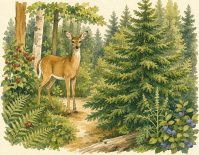
Observe a temperate forest scene and identify visible plants and animals. Mark observed plants by clicking the green button next to each name
-
Classify plants as coniferous or deciduous, evergreen or deciduous; determine whether plants are edible or inedible; identify plants as native or introduced species.
-
Explore why deciduous trees shed their leaves
-
Investigate the phenomenon of crown shyness and discuss why tree crowns do not touch
-
Solve a forest mystery by explaining why spruce cones may be found under a beech tree (woodpecker’s anvil)
-
Build food chains by dragging and placing animals into the correct positions
-
Connect everyday objects to forest resources in an indoor scene
Activities:
Equator Quest- Learn how to dress, pack, and prepare for a journey through the forest
- Read cloud patterns to predict weather and use constellations for navigation
- Identify edible berries and medicinal plants for first aid in the wild
- Use survival techniques like fire-starting, water purification, and fishing
- Follow rivers and natural signs to find their way back to civilization
Activities:
-
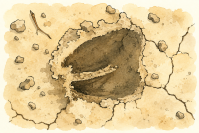
• Identify key tundra characteristics such as open landscapes, frozen ground (permafrost), and low-growing vegetation• Analyze real environmental clues to recognize the tundra biome• Apply scientific reasoning in a survival scenario set in extreme conditions• Investigate unusual tundra phenomena, including sinkholes, stone spheres, and glacier mice• Evaluate which tools and resources are useful for survival in cold environments• Explore how limited fuel availability affects fire-building decisions• Examine how tundra animals adapt to harsh climates and how their behavior affects safety• Search for potential food sources in a landscape that appears empty at first glance• Strengthen classification skills by identifying animals that do not belong in the tundra biome
Activities:
- Explore the equator’s climate zones through an interactive world map
- Dress appropriately for tropical weather challenges
- Identify venomous snakes and learn about their dangers
- Understand symptoms and prevention of tropical diseases
- Discover and classify the rich biodiversity of the Amazon, Congo, and Indonesian jungles
Activities:
- Navigate common household risks like faulty appliances, fires, and injuries
- Make safe choices in outdoor scenarios — from sunburns to stray dogs
- Practice storm safety and water safety with realistic scenarios
- Identify warning signs, assess risks, and take responsible action
- Build independence, awareness, and confidence in everyday decisions
Animal and Human Body Language
Activities:
-
• Identify animals by their footprints• Examine bite marks and tree damage to determine which animal left each trace• Match animals to their droppings• Match animals with their natural shelters (burrows, hollows, lodges, etc.)• Search for camouflaged animals hidden in plain sight• Study real wildlife photos and infer which animals were present and what they were doing
Pet Care
Activities:
Activities:
- Learn how to choose a suitable pet
- Understand how to create a proper habitat for different pets
- Explore the concept of biomes and identify them on a map
- Discover appropriate feeding practices for pets
- Recognize basic signs of pet health issues and when to seek veterinary help
Multiple Intelligences in Animals
Activities:
- Study the "Multiple Intelligences" concept and its applicability to animals.
- Research and comparison of ten animals with sufficiently high intelligence based on ten criteria: linguistic intelligence, ability to count, problem-solving skills, spatial intelligence, trainability, multiple intelligences, empathy, self-awareness, ability to adapt to the environment, and sense of humor.
- Practical assignment: attempt to replicate the knots that a weaver bird ties when creating its nest.
Activities:
- Understand how the animal kingdom differs from other kingdoms
- Sort animals by their phyla
- Determine which animal is being discussed in the medieval text
- Draw a coat of arms for the animal phylum according to the rules of heraldry
Activities:
- Selection of suitable habitats for different vertebrates
- Sorting vertebrates into fish, amphibians, reptiles, birds, and mammals
- Identifying common characteristics of fish, amphibians, reptiles, birds, and mammals
- Drawing the coat of arms of the class of mammals according to the rules of heraldry
Activities:
- Solve a riddle inspired by Aristotle
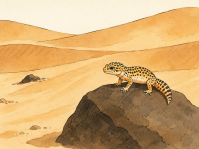
- Sort reptiles from non-reptiles
- Compare reptiles, amphibians, and birds by key traits
- Explore reptile eggs, breathing, skin, development, and body temperature
- Compare fish scales and reptile scales
- Identify what reptile skin can and cannot be covered with
- Match newly hatched reptiles to their orders
- Sort reptiles into major groups: turtles, crocodilians, squamates, and tuataras
- Guess a hidden reptile and name its order
- Build food chains with reptiles as consumers and top predators
- Compare dinosaur and lizard leg structure
- Explore how reptiles inspired myths, symbols, and scary stories
- Decide whether scary-looking animals are always the most dangerous
Activities:
- Identify animals that are not mammals
- Compare mammal traits with traits of reptiles and birds
- Investigate exceptions to common mammal patterns
- Explore warm-bloodedness, milk feeding, skin coverings, breathing, heart structure, and reproduction
- Learn how mammalian middle ear bones evolved
- Classify mammals by placing them on a phylogenetic tree
- Solve mystery-animal challenges using mammal orders
- Build mammal food chains
- Read and interpret an old-fashioned zoology description
- Identify animals by their feet and connect structure to lifestyle
Animal Tracking
Activities:
- Identify animals by their footprints
- Analyze bite marks and tree damage to infer animal activity
- Recognize animals based on their droppings
- Match animals with appropriate natural shelters (burrows, hollows, lodges, etc.)
- Locate camouflaged animals hidden in plain sight
- Interpret real wildlife photos and explain what animals were doing based on visible signs